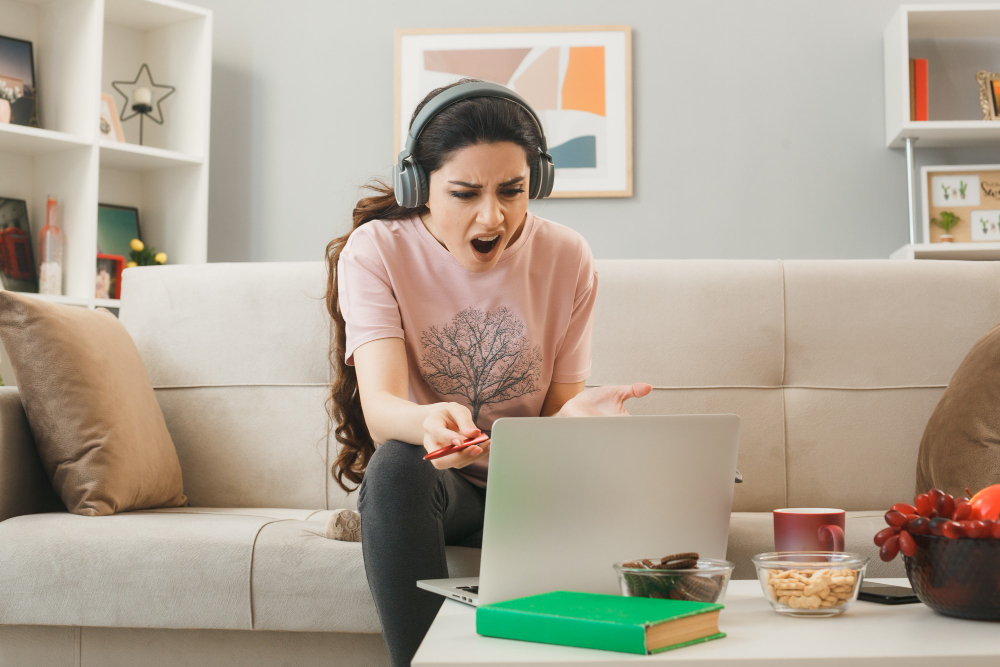


Let’s be honest for a moment. You’re sitting in front of your laptop, the professor’s voice is a steady drone in the background, and you realize you’ve just spent the last ten minutes mentally reorganizing your bookshelf. The cursor blinks, the lecture slides change, and you have absolutely no idea what was just said. If this scene feels uncomfortably familiar, you are not alone.
The shift to digital learning has presented a unique paradox: we have the world’s information at our fingertips, yet our ability to absorb it seems to have slipped through them. We often blame ourselves for a lack of willpower, but the truth is far more complex and, thankfully, more fixable. Focus isn’t just a moral muscle you need to flex harder; it is a neurobiological process that can be optimized. By understanding the science of how your brain works, you can stop fighting yourself and start working with your biology to master the art of concentration in a distracting digital world.
The Myth of Multitasking: Why Your Brain Isn’t Built for Zoom and Scrolling
One of the most pervasive habits during online classes is the illusion of multitasking. You might think you can listen to the lecture, glance at a text message, and jot down a note all at once. But neuroscience tells a different story.
When you believe you are multitasking, your brain is actually engaging in what researchers call “task switching.” Your prefrontal cortex, the CEO of your brain responsible for decision-making and focus, has to stop one set of neural rules and activate another every time you switch your attention. A study published by the American Psychological Association highlights that this constant switching can cost as much as 40% of your productive time.
In the context of an online class, this is catastrophic. Every time you look at your phone to check a notification, your brain disengages from the lecture. When you look back, it has to work to re-establish the context of what the professor is saying. This “attention residue” means that even when your eyes are back on the screen, your brain is still partially processing the text message you just read. The result? You feel exhausted, and the information never moves from your short-term memory into long-term storage. The first step to improving focus is acknowledging that you can only process one stream of complex information at a time.
Harnessing Neurochemistry: The Power of Dopamine Regulation
To truly understand how to focus, you have to understand dopamine. Popular culture often labels dopamine as the “pleasure chemical,” but in reality, it is more accurately described as the “motivation molecule.” It is released not just when you receive a reward, but in anticipation of one.
Here is the problem: online classes exist on the same device as your most potent dopamine triggers—social media, video games, and instant messaging. Every “ping” and red notification badge offers a tiny, unpredictable reward that spikes your dopamine levels. Compared to the slow, steady burn of a lecture, the internet provides a firehose of stimulation. Your brain, wired for survival, will naturally gravitate toward the activities that offer the highest immediate reward.
To improve focus, you must engage in “dopamine fasting” or, more accurately, “dopamine regulation.” This doesn’t mean swearing off all pleasure, but rather strategically reducing the noise so the signal becomes clearer.
The 10-Minute Rule: Before your class begins, take ten minutes to engage in something “boring.” Look out the window, stretch, or sit in silence. This lowers the baseline of stimulation, making the lecture content engaging enough for your brain to latch onto. If you go straight from the dopamine firehose of TikTok into a class, the lecture will feel unbearably dull by comparison, and your brain will rebel.
Active vs. Passive Consumption: The Note-Taking Revolution
The biggest reason your mind wanders during online classes is passivity. Watching a lecture can feel like watching television. When you are a passive viewer, your brain goes into a default mode network—the state it’s in when you daydream.
The antidote is active engagement. But not all note-taking is created equal. Transcribing every word the professor says (typing verbatim) is actually a passive activity. It requires little cognitive processing. It’s just a mechanical act.
Research on educational psychology consistently shows that generative note-taking is far superior. This involves processing the information and rephrasing it in your own words.
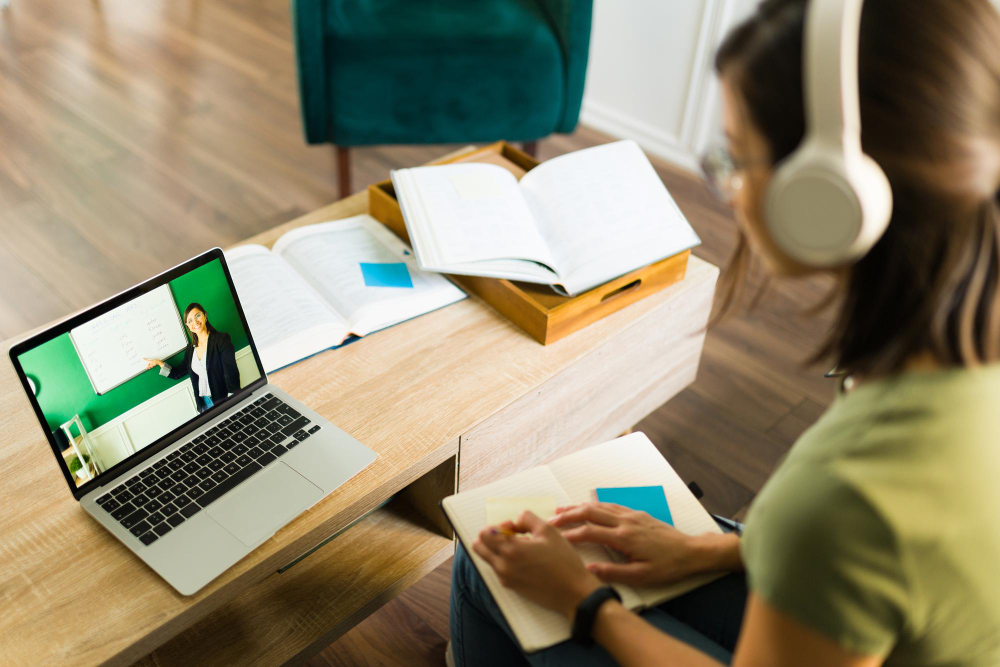
The Pen-and-Paper Advantage: Consider using a physical notebook and a pen. While typing allows for speed, writing by hand is slower. This forces your brain to listen, summarize, and prioritize information in real-time. It is a cognitive workout that keeps your brain locked into the lecture. Furthermore, the physical act of writing activates sensory-motor regions of the brain that typing does not, creating a stronger memory trace.
Engineering Your Environment: Priming the Visual Field
In a physical classroom, the environment is designed for learning. Desks face the front, and distractions are minimal. In your home, your environment is designed for living, relaxing, and eating. You cannot rely on willpower alone to overcome environmental cues; you have to change the environment itself.
The science of “choice architecture” suggests that if you make the desired behavior easy and the undesired behavior hard, you will win every time.
Digital Hygiene: Before the class starts, put your phone in another room. Not face down on the desk, not in your pocket, but in another room. The mere sight of your phone drains cognitive resources because a part of your brain is subconsciously monitoring it for updates.
Tab Closure: Close every single browser tab that isn’t directly related to the class. Visual clutter in your digital space creates cognitive load. A clean desktop signals to your brain that it is time for a single, specific task.
Lighting Matters: Circadian neuroscience tells us that exposure to bright, blue-enriched light during the day promotes alertness. If possible, position yourself so that natural light hits your face. If not, use a bright, cool-toned lamp pointed at you, not at the screen. This signals to your suprachiasmatic nucleus (your internal clock) that it is time to be awake and alert.
Strategic Movement and Posture: The Body-Brain Connection
We often treat the body and brain as separate entities. We think mental work is purely cerebral, but the body is the platform upon which the brain operates. If your body is sedentary and slumped, your brain gets the signal that it’s time to rest.
A study from the Journal of Applied Physiology noted that sitting for long periods leads to reduced blood flow and oxygen delivery to the brain. This results in brain fog and drowsiness.
The Dynamic Learner: You don’t need to do burpees during a lecture, but micro-movements can sustain focus. Consider an upright, active sitting posture. Better yet, if your setup allows, consider using a standing desk for part of the lecture. When you stand, your physiological arousal increases slightly, which can sharpen attention.
The 20-20-20 Rule: For every 20 minutes of screen time, look at something 20 feet away for 20 seconds. This isn’t just for your eyes (to reduce digital eye strain); it’s a reset button for your brain. It allows your accommodation reflex to relax and gives your attentional resources a brief micro-break so they don’t deplete entirely by the end of the hour.
The Pomodoro Technique and Temporal Boundaries
Online classes often lack the natural boundaries of a physical class. You don’t have the walk to the next room or the chatter in the hallway to delineate the end of one cognitive chunk and the start of another. This leads to mental fatigue.
While you can’t pause a live lecture, you can structure your self-study time using the Pomodoro Technique, developed by Francesco Cirillo. The principle is based on the brain’s ultradian rhythm—the 90-120 minute cycles of high-frequency brain activity we go through during the day.
How to apply it: During recorded lectures or self-study, work in focused sprints of 25-50 minutes, followed by a 5-10 minute break. During the break, do not look at another screen. Do not check Instagram. This engages a different neural network than the one you just fatigued. Walk around, get water, or stretch. This deliberate disengagement allows your brain to consolidate information subconsciously and return to the next sprint with renewed energy.
The Breath as a Remote Control for the Nervous System
When you lose focus, it is often because your brain has detected a threat (boredom is perceived as a mild stressor by the brain) or because your mind has wandered to an anxious thought. In these moments, your sympathetic nervous system (fight or flight) activates. It’s nearly impossible to focus when you are in a state of low-grade panic or anxiety.
You have a direct line to your nervous system: your breath.
Physiological Sigh: Before a difficult class or when you feel your attention fraying, use a technique popularized by neuroscientist Andrew Huberman: the physiological sigh. Take a deep inhale through your nose, and then a short, sharp second inhale to fully inflate the alveoli in your lungs. Then, a long, slow exhale through your mouth. This pattern is the fastest known way to down-regulate stress and bring your prefrontal cortex back online. It resets the diaphragm and lowers your heart rate instantly, clearing the way for concentration.
Nutrition and Hydration: The Invisible Fuel
You wouldn’t expect a car to run on fumes, yet we expect our brains to run on coffee and a granola bar eaten four hours ago. The brain consumes about 20% of the body’s energy despite being only 2% of its mass. It requires steady fuel.
Glucose Regulation: The brain runs primarily on glucose, but the source matters. A sugary breakfast or lunch leads to a rapid spike in blood sugar, followed by a crash. That crash manifests as brain fog and lethargy exactly when you need to focus. Prioritize protein, healthy fats, and complex carbohydrates to provide a slow, steady release of fuel.
Hydration: Even mild dehydration (as little as 2% loss in body water) can impair cognitive performance, particularly attention and executive function. Keep a large water bottle at your desk. Sip consistently. Thirst is a distracting signal that your brain generates to get you to fix a homeostatic imbalance. Preempt that signal to stay locked in.
Reframing Your Identity: From Student to Active Agent
Finally, the most powerful tool is psychological. If you log into a class thinking, “I hope this professor keeps me entertained,” you have given away all your power. You have set yourself up as a passive consumer waiting to be served.
Instead, shift your mindset to one of active extraction. View the lecture as a resource that you are mining for value. Your job is not to sit back and be taught; your job is to go in and take the information.
The Question Mindset: Before the class starts, write down three questions you want the lecture to answer. This primes your reticular activating system (RAS)—the part of your brain that filters information—to look for specific answers. When the professor touches on those points, your brain will snap to attention because it has been looking for that specific piece of the puzzle. This transforms you from a passenger into the pilot.
Conclusion
Struggling to focus during online classes is not a character flaw. It is a biological response to an environment that is neurologically mismatched to deep learning. By implementing these science-backed methods—regulating dopamine, taking notes by hand, optimizing your environment, managing your body state through breath and movement, and reframing your mindset—you are not just fighting distraction; you are redesigning your relationship with information. Start small. Pick just one of these strategies for your next class. The ability to focus deeply is not a gift; it is a skill, and it is one you are now equipped to rebuild.